Home / New Session of alinnea’s Electric Vehicle Dialogue Series in Europe and Spain
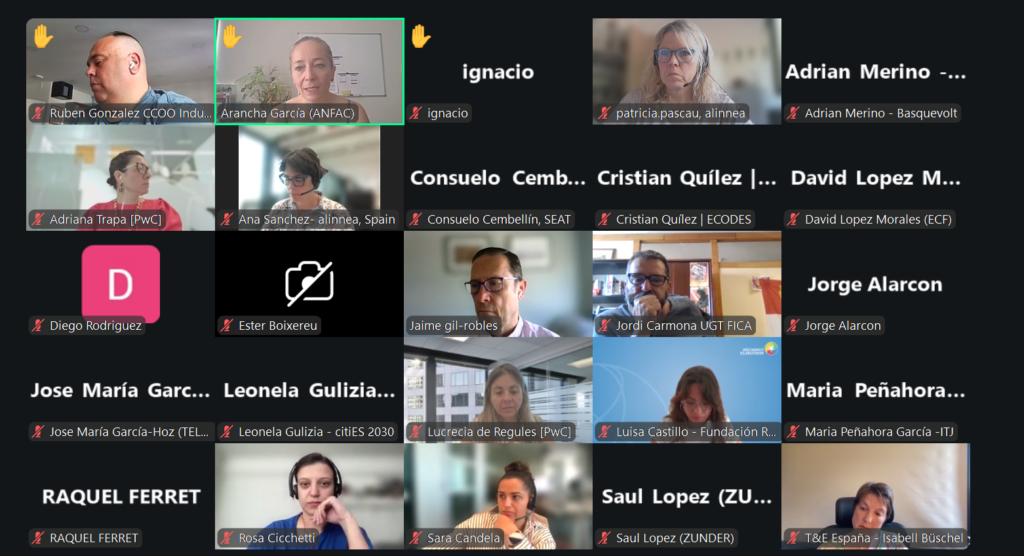
alinnea has held the second session of its recurring dialogue series on the evolution of electric vehicles in Europe and Spain. The series provides a forum for ongoing monitoring and shared analysis, bringing together representatives from industry, trade unions, public administrations and civil society organisations on a regular basis to exchange information and reflect on the key developments shaping the sector. The meeting provided an opportunity to review market developments, the evolving regulatory landscape and the main industrial challenges that will shape the transition to electric mobility.
During this second session, participants discussed recent developments in the Spanish electric vehicle market, paying particular attention to the status of the Auto Plus programme and its potential impact on vehicle registrations. They reviewed the implementation process of the programme, as well as issues relating to European-origin requirements for batteries and components and the planned operation of the support scheme. Participants also noted that the market continues to show positive momentum, with growth in both battery electric vehicles (BEVs) and plug-in hybrid electric vehicles (PHEVs) during the first months of the year. Specifically, Spain experienced growth with a battery electric vehicle share of 9%, representing an increase of 2 percentage points compared to the same period in 2025.
Another key topic of discussion was the industrial transformation of Spain’s automotive sector. Participants agreed that electrification continues to attract new industrial investment, particularly through international partnerships and the arrival of new manufacturers, while noting that the greatest challenge lies within the components industry. In this context, they stressed the importance of anticipating the transition of suppliers most exposed to technological change and supporting this process through targeted strategies aimed at preserving employment and strengthening the national automotive value chain.
The discussion also addressed the impact of new international partnerships and the ongoing reorganisation of the European automotive industry on the sector’s competitiveness. Participants highlighted the importance of leveraging foreign investment to generate greater added value in Spain by expanding research, development and innovation activities while strengthening the domestic supplier ecosystem. They also noted that the temporary coexistence of different powertrain technologies could enable a more orderly industrial transition while the supply chain continues to adapt to electric mobility.
One of the main topics of discussion was the ongoing European debate on the concept of local content and the future definition of what can genuinely be considered “Made in Europe.” Participants analysed how these criteria could influence access to public support schemes and industrial policy instruments, as well as manufacturers’ investment decisions. In this context, they emphasised the need to strengthen Europe’s industrial capacity without undermining the sector’s competitiveness. It was noted that much of the European automotive industry relies on an integrated production ecosystem that includes not only manufacturing plants within the European Union but also facilities in countries such as Morocco and Türkiye, where many European and Spanish suppliers are also established. Participants agreed that increasing European content should be pursued progressively, avoiding localisation requirements that could significantly increase the cost of electric vehicles and reduce their competitiveness against manufacturers from third countries.
In this regard, participants highlighted the recent joint proposal submitted to Brussels by Stellantis, Renault and Volkswagen as an important step forward, representing the first common position reached by three of Europe’s largest automotive manufacturers on the definition of a European vehicle. The proposal suggests assessing the European character of production from an aggregated perspective, whereby a manufacturer would be considered European if at least 70% of its production takes place in Europe, while a vehicle would qualify as European if at least 70% of its value, excluding the battery and including components, materials and technology, originates within the European Union. Participants viewed this approach as a way to strengthen European industrialisation while preserving the sector’s competitiveness.
The session also provided an opportunity to discuss the need for a clear, stable and pragmatic European regulatory framework capable of facilitating investment and safeguarding European industrial production. Participants agreed that the transition should combine climate ambition with regulatory certainty, avoiding unnecessary complexity or delays in secondary legislation that could create uncertainty for businesses. They also underlined the importance of strengthening workforce training and promoting complementary measures, such as social leasing, to broaden access to electric vehicles and support market demand in the coming years.
The discussion further explored the need for future European industrial policy to go beyond vehicle assembly and promote knowledge creation, technological development and the transfer of industrial capabilities to Europe. Participants stressed that incoming international investment should contribute to strengthening Europe’s industrial base and enhancing the strategic autonomy of the electric vehicle sector.
The final part of the dialogue focused on the strategic importance of critical raw materials and the evolution of the European regulatory framework. Participants highlighted the opportunity for Spain to develop projects related to lithium extraction and other critical raw materials, as well as the importance of upcoming European decisions on decarbonisation and industrial policy. In addition, several proposals were put forward for future alinnea activities, including further analysis of the economics of transport electrification and the incorporation of new areas of discussion such as industrial digitalisation, artificial intelligence, connected vehicles and autonomous vehicles.
This second dialogue further consolidates the forum established by alinnea as a permanent platform for discussion and analysis of the evolution of electric vehicles, reinforcing the organisation’s commitment to monitoring the industrial, regulatory and strategic challenges that will shape the future of electric mobility in Europe and Spain.