
Home / Strengthening the Electric Vehicle Value Chain through Batteries and Critical Raw Materials
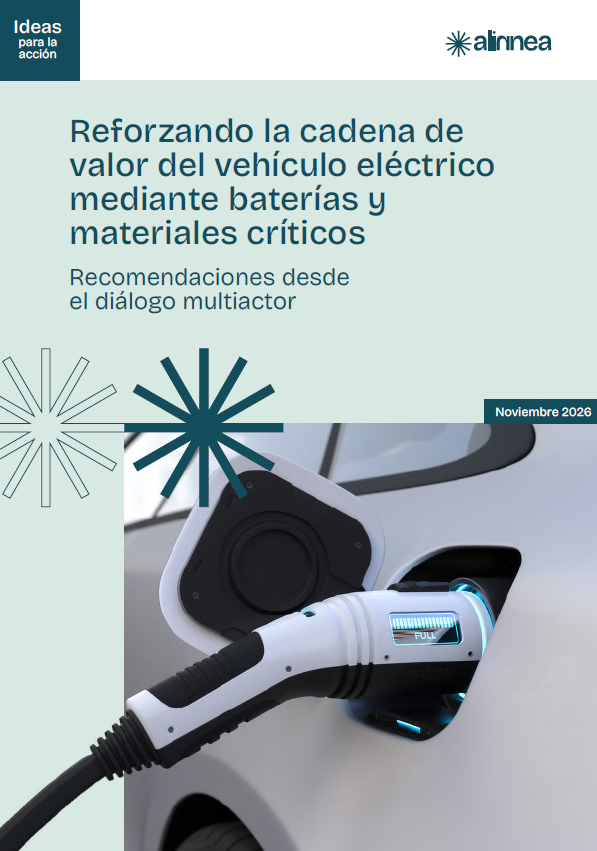
The report analyses the conditions needed to develop a competitive, sustainable and resilient battery and critical raw materials value chain in Spain—an essential component in linking the climate transition with industrial development and strategic autonomy—and the main obstacles to its consolidation. It groups the bottlenecks identified into ten areas: the value chain and industrial capabilities, critical raw materials and security of supply, energy and operating costs, regulation and administrative frameworks, technology and industrial uncertainty, investment and financing, talent and skills, European competitiveness and strategic autonomy, demand and markets, and governance and coordination. The document examines how to overcome these barriers to translate Spain’s industrial, geological, energy and scientific potential into operational, competitive and lasting production capabilities, without creating new dependencies.
Based on this assessment, the report sets out a roadmap with short-, medium- and long-term actions across four areas: enabling conditions; the value chain, technologies and decarbonisation; demand and markets; and competitiveness and strategic autonomy. It develops three priority proposals: establishing a National Training Strategy supported by a Talent Observatory and a National Training and Skills Development Programme for batteries and critical raw materials; promoting a dialogue forum connecting industry, society and local communities around battery manufacturing, alongside an association of manufacturers with industrial operations in Spain; and establishing a common framework for a social licence to operate, shared value and a just transition in mining projects. These measures are complemented by recommendations on administrative simplification and regulatory stability, financial instruments tailored to the industrial cycle, energy competitiveness, scaling up gigafactories, innovation, circularity and traceability, lead markets for batteries and recycled materials, supply diversification, and technology transfer from foreign investment, with the aim of consolidating an integrated, circular and resilient European value chain.
This report is part of the ‘Ideas for Action’ series and presents the conclusions of the working group convened by alinnea, which brought together more than 30 professionals from public and private sector organisations, financial institutions, industry, trade unions and civil society between April and July 2026.
Participation by these organisations does not necessarily imply their endorsement, through specific commitments, of the ideas presented in the final document.
Length: 77 pages.
Available languages: Spanish and English (coming soon).
Drawing on a working group convened by alinnea, this report identifies bottlenecks relating to the value chain and industrial capabilities, critical raw materials and security of supply, energy and operating costs, regulation and administrative frameworks, technology and industrial uncertainty, investment and financing, talent and skills, European competitiveness and strategic autonomy, demand and markets, and governance and coordination.