Home / Spain promotes biregional dialogue on green industry at COP30
The most recent edition of the Conference of the Parties (COP30) took place in Belém, Brazil, last November, but the discussions held there remain essential for guiding climate action in the years ahead. The need to translate commitments into concrete policies, accelerate investment in green industry, and strengthen international cooperation continues to be urgent.
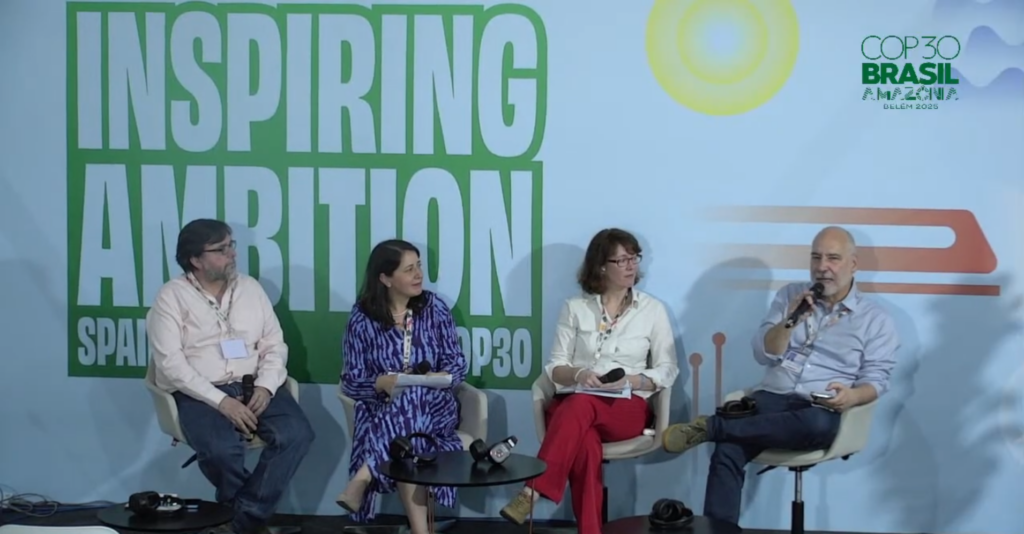
In this context, the event on accelerating the green industry agenda, organised at the Spain Pavilion by the Ministry for the Just Transition and the Demographic Challenge and the Biodiversity Foundation, in collaboration with alinnea and ICATALIST, SL, is particularly relevant in keeping sight of the strategic debates that will shape the implementation of Nationally Determined Contributions (NDCs) in Latin American countries.
The event became a space for strategic dialogue to address how cooperation between Spain, Latin America, and multilateral organisations can accelerate the implementation of Nationally Determined Contributions (NDCs) through the development of a strong, inclusive, and competitive green industry.
Speakers agreed that implementing the NDCs requires not only climate ambition, but also stable regulatory frameworks, coherent industrial policies, and innovative financing mechanisms capable of scaling up private investment and ensuring a just and inclusive transition. They also emphasised that public–private cooperation and multi-stakeholder dialogue are indispensable conditions for overcoming structural barriers such as infrastructure gaps, regulatory weaknesses, and limited coordination across levels of government.
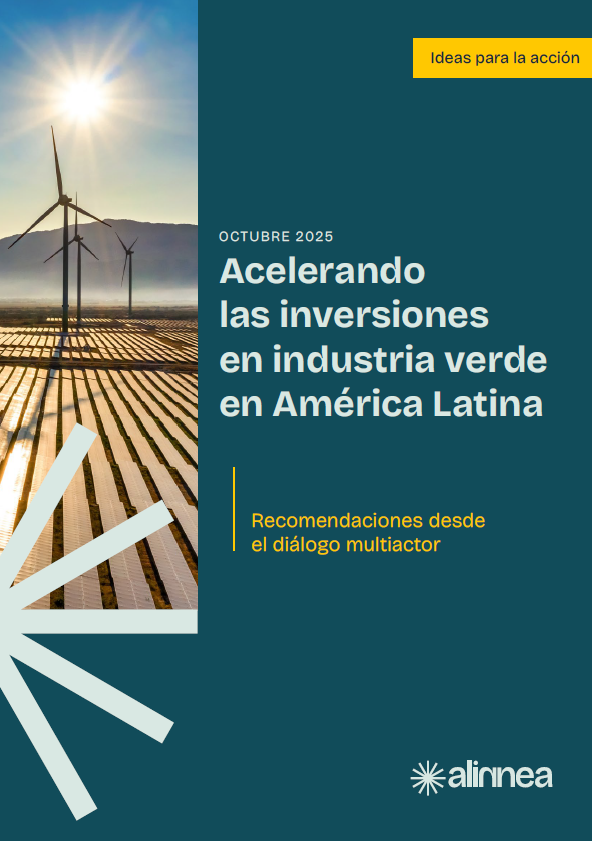
The event brought together representatives from public institutions, international organisations, the private sector, and civil society. All participants highlighted the main bottlenecks that continue to hinder investment in green industry in the region—particularly in critical areas such as the development of sustainable value chains, the responsible extraction of strategic raw materials, and industrialisation linked to the energy transition. These challenges are also reflected in the report produced by the working group promoted by alinnea, which between June and September 2025 identified key challenges and opportunities for accelerating investment in the region.
During the discussion, the need to strengthen biregional cooperation between Spain and Latin America was underscored in order to advance key sectors such as lithium, copper, batteries, and transport electrification. The roundtable highlighted that complementarity between regions can become a strategic advantage: while Latin America has essential natural resources for the energy transition, Spain and the European Union possess technological, regulatory, and industrial capacities that can accelerate the development of new green value chains.