Home / The Working Group on Climate Finance for the Agrifood Sector concludes its sessions with a roadmap to support the sector’s transition

The Working Group on Climate Finance for the Agrifood Sector, convened by alinnea, held its final review and feedback session on Tuesday, 17 November, concluding a dialogue process spanning three working sessions. The meeting enabled participants to review the findings gathered throughout the year and examine a proposed roadmap that will form the basis of the final report.
The process addressed a central question for the transformation of Spain’s agrifood system: how to ensure that public and private finance effectively supports the investments needed to reduce emissions, adapt to climate change, and maintain the economic viability of farms and businesses. Discussions connected the European funding framework with the needs of farmers, livestock producers, cooperatives, industry and other value chain actors, bringing together perspectives from public administration, financial institutions, research and civil society.
One of the main findings is that mobilising more resources also requires improving the conditions that enable their use. Fragmented instruments, administrative complexity, limited advisory support and difficulties in sharing risk constrain the ability to turn available finance into investments that deliver climate and economic benefits.
The first session, held on 28 May, focused on the climate finance landscape for Spain’s agrifood system, with particular attention to the Common Agricultural Policy (CAP), the Multiannual Financial Framework and other European and national instruments. The dialogue examined the sector’s investment needs, barriers to accessing resources, and the importance of aligning agricultural, environmental, rural development and innovation policies.
The second session, on 30 June, addressed climate risk, resilience and the future of agricultural insurance. Discussions explored the pressures that climate impacts place on the protection system and the need to connect insurance with a broader approach to risk management, encompassing information, prevention and the adaptation of production models.
The third meeting, held on 29 September, turned to practical examples and the conditions needed to expand financing across the agrifood value chain. Participants examined collaborative initiatives involving producers, cooperatives, lead companies and finance providers, alongside the barriers to extending these models to more regions, farms and value chains.
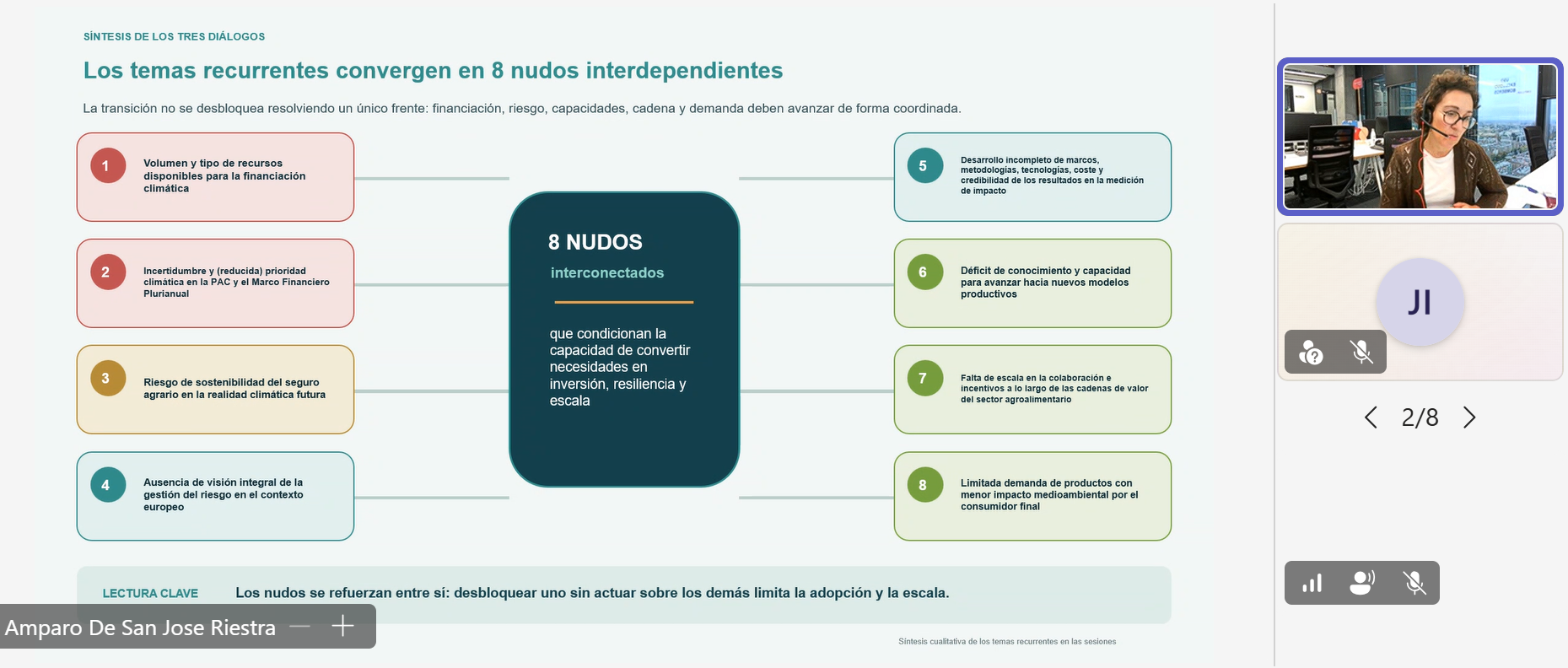
Drawing on these dialogues, the proposal presented at the final session organised the findings around eight interconnected challenges: the volume and suitability of financial resources; the CAP’s climate focus; the sustainability and accessibility of agricultural insurance; integrated risk management; clarity in measurement and certification frameworks; technical and financial capabilities; collaboration among value chain actors; and demand for products with a lower environmental impact.
The review session reinforced the role of prevention in guiding investment. Contributions highlighted the importance of financing measures that reduce farms’ exposure and vulnerability, complementing mechanisms that respond to losses. This means connecting climate and agronomic knowledge with financing decisions and assessing investments for their capacity to prevent future damage.
Water featured prominently in this discussion. Participants highlighted the need to consider future water availability when planning investments and changes in production, so that decisions strengthen farms’ medium- and long-term resilience.
The discussion also emphasised that financial instruments must reflect the sector’s diversity across production systems and regions. Financing needs, investment payback periods and the capacity to manage change vary according to a farm’s size, activity and starting conditions. Particular attention was given to ensuring that solutions are accessible to family farms and that the costs of advice, measurement and verification allow them to participate.
Generational renewal was also considered from this perspective: enabling the transition requires attention to access to land and credit, investment payback periods and business continuity.
Another central theme was the need to involve the entire value chain. Farmers and livestock producers face investments, changes in management practices and potential temporary income losses, while some of the benefits of the transition accrue to other actors and society as a whole.
The options explored included long-term supply contracts, guarantees, investment co-financing, and combinations of grants, credit, insurance and technical assistance. Bringing farms and projects together through cooperatives and value chain partnerships could improve access to these instruments, spread costs and create a scale more attractive to investors.
Mobilising private capital also requires greater clarity about the environmental outcomes being financed and how they are verified. The group examined the diversity of standards and methodologies, measurement costs, and the need for verifiable evidence suited to different production contexts. It also highlighted the importance of precisely defining the environmental attributes of products and practices to support informed investment and purchasing decisions.
On demand, contributions at the final session broadened the focus beyond communication and certification. Price, availability and ease of purchase influence consumer choices. Discussions explored the potential of retail, food services and public procurement to generate more stable demand, supported by coordinated supply arrangements that enable small producers to participate. The aim is for this increased demand to deliver a verifiable economic return to those implementing changes in production.
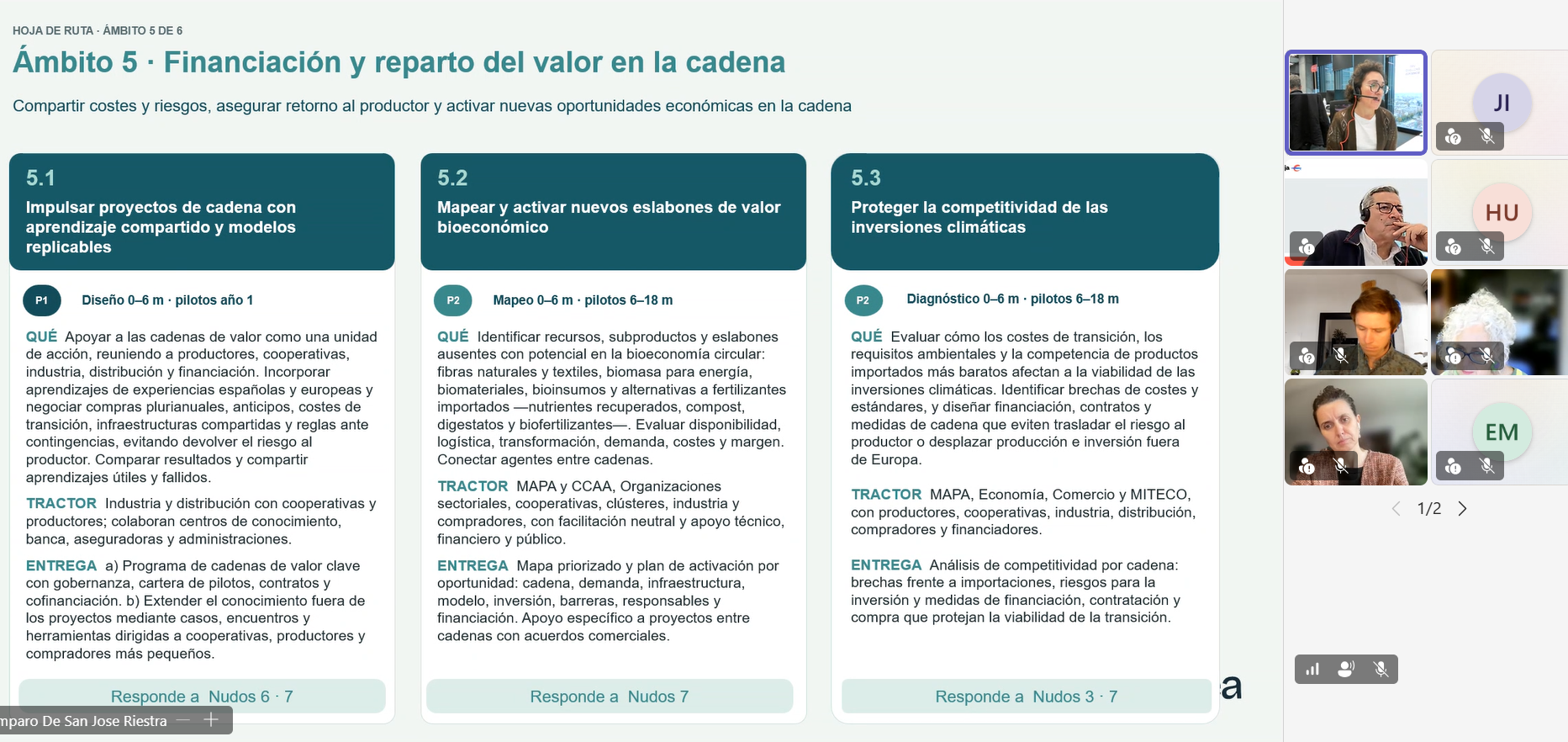
The roadmap submitted for review organises the proposed measures into six complementary areas: public finance, risk and insurance, private finance, skills and advisory support, value chains, and demand. To put these areas into practice, six potential initiatives were presented:
The review emphasised that these proposals should build on existing programmes, capabilities and collaborative networks. It also identified the need to adjust timelines, clarify potential leadership roles and assess the resources required for implementation.
Following the contributions received during this session, alinnea will continue revising the final report, bringing together the findings and proposed actions. An updated draft is expected to be shared with participants before the end of the year, with a public presentation of the results planned for early 2027.
The conclusion of the sessions opens a new stage in bringing the group’s insights into the forums where policies are designed, financial instruments are structured and investment decisions are made. The agrifood system’s climate transition requires connecting finance, knowledge, prevention and demand through solutions tailored to local conditions and capable of sustaining the livelihoods and incomes of those who produce our food.
At alinnea, we thank all the organisations and professionals who contributed their expertise and insights to this collective dialogue.