The second annual report on the EV Transition Check 2026 was presented today in Brussels, in collaboration with the Irish Presidency of the Council of the European Union. The study, prepared by the ICCT with the support of alinnea and other European think tanks, measures the progress of transport decarbonisation in Europe and across different areas towards a zero-emission scenario.
This second edition includes not only passenger cars, but also data on buses and trucks.
The report is divided into five sections that show different dimensions of decarbonisation progress in road transport.
The first section, on manufacturers’ emission reduction targets and the uptake of the battery electric vehicle (BEV), shows that the manufacturers’ trend is leading them to meet the targets of the European CO2 emission standards for new vehicles. In the case of passenger cars, as of June 2026, carmakers were less than 2 g CO₂/km away from reaching the average target of 93 g CO₂/km set for the 2025-2027 period.
On the other hand, according to the 2024 data on heavy-duty vehicles (the latest available from the European Commission), manufacturers met, on average and one year ahead of schedule, the 15 % CO₂ emission reduction target set for 2025.
The second section of the report focuses on affordability. Under the European Union’s criteria, affordable vehicles are those priced below €30,000. In this regard, the number of affordable battery electric vehicle (BEV) models available in the EU rose to 35 in 2025, mainly owing to the fall in battery prices, which are so far the most expensive component of a BEV.
Another key aspect of vehicle affordability is running costs. Battery electric vehicles (BEVs) are cheaper than petrol internal combustion engine vehicles (33 % cheaper in 2025), even for those who rely exclusively on public charging (5 % cheaper), and they already were before the 2026 oil crisis.
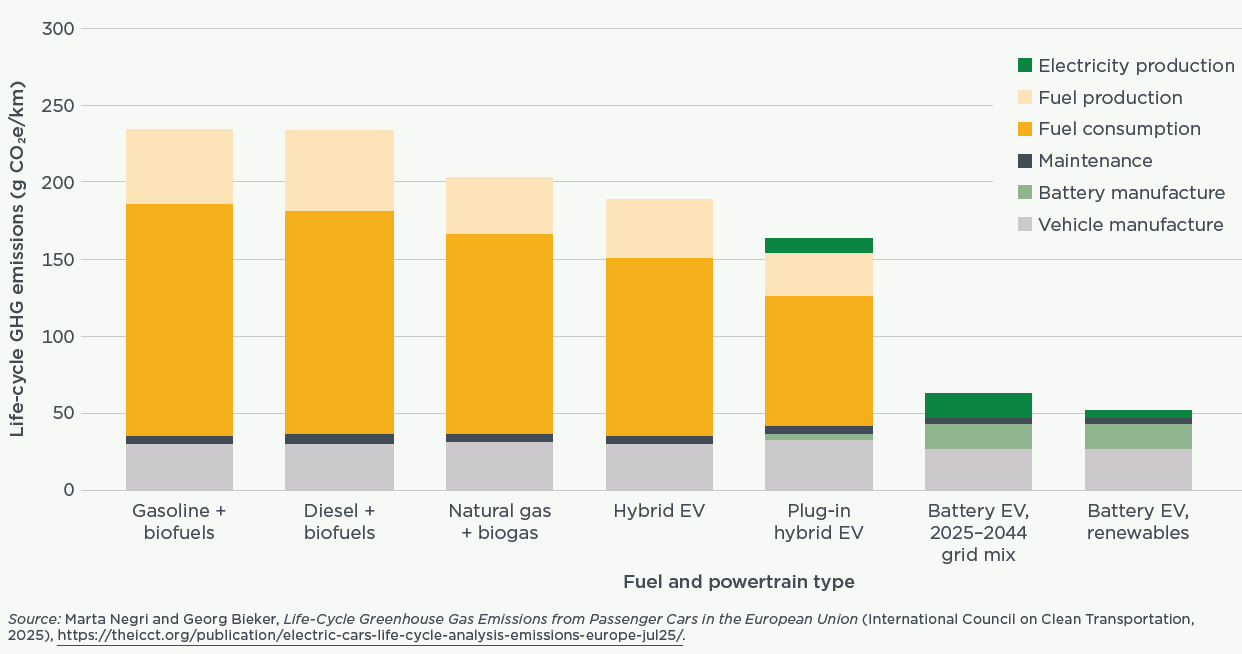
The third section of the report focuses on the climate and health impacts of vehicles. Among all economically viable options for passenger cars and trucks, battery electric vehicles (BEVs) offer the greatest climate and public health benefits compared with internal combustion engine vehicles. Moreover, taking the vehicles’ life cycle into account, we can see that the greenhouse gas emissions of a battery electric passenger car (BEV) are 73 % lower than those of a petrol car, while those of a long-haul battery electric truck are 86 % lower than those of a diesel internal combustion engine truck.
When analysing the climate and health benefits of the different powertrains, it is important to assess emissions under real-world driving conditions rather than those recorded during type approval. This is particularly relevant for plug-in hybrid vehicles (PHEVs) in the EU, which show a considerable gap: their real-world CO₂ emissions are 4.6 times higher than type-approval emissions, and this gap continues to widen despite the increase in their average electric range. This gap indicates that, on average, plug-in hybrids (PHEVs) do not currently deliver the emission reductions relative to combustion vehicles suggested by type-approval values.
The study shows that the number of public charging points in the EU has increased almost eightfold since 2020, reaching 1.16 million in June 2026.
In 2025, alinnea published the analysis of electric mobility in Spain: current situation, bottlenecks and proposals for increasing electric vehicle uptake which warned that one of the key challenges for the purchase of electric vehicles in Spain was the limited number of charging points available and the lack of detailed information on their availability. Two years later, this study shows that there is currently sufficient public charging infrastructure for the vehicle fleet on the road in the EU.
The report closes by asking whether the electrification of the automotive sector is helping to boost industrial competitiveness in Europe. In terms of energy dependence, in 2025 the EU imported oil and natural gas worth €336.7 billion —an amount equivalent to 97 % of its consumption of oil and petroleum products—, while it was a net exporter of electricity, which shows the importance of electrifying the sector for the Union’s budget. If we look at another competitive factor such as job creation, progress in the battery supply chain is translating into rising employment in the sector, with an estimated 62,300 jobs in this value chain in Europe in 2025.