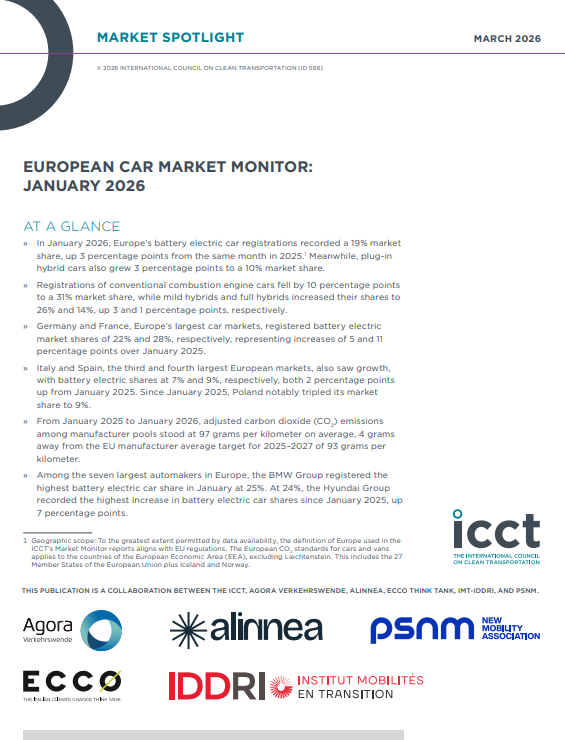
As the transition toward zero-emission electrified mobility accelerates, monitoring the automotive market becomes a useful reference point for assessing manufacturers’ strategies in response to the new emission reduction targets.
In order to provide reliable and up-to-date data to the public debate, the think tanks Agora Verkehrswende (Germany), alinnea (Spain), ECCO Climate (Italy), the International Council on Clean Transportation (ICCT), the Mobility in Transition Institute (IDDRI-IMT, France), and the Polish Association for New Mobility (PSNM, Poland) publish monthly data on the average specific emissions of newly registered vehicle fleets in the European Economic Area, both overall and by country. These data make it possible to track manufacturers’ compliance gap with respect to the CO₂ reduction targets (Regulation 2019/631) set for the 2025–2027 period, as well as the reduction of CO₂ emissions from new vehicles through 2035.
alinnea provides the report data with a particular focus on Spain, the fourth-largest automotive market in Europe.
The monitoring includes details on registrations by powertrain type: battery electric vehicles (BEV), plug-in hybrid vehicles (PHEV), full hybrids (HEV), and mild hybrids (MHEV), as well as a quarterly update on: the evolution of charging infrastructure, the production, purchase, and registration of vans, and corporate electric vehicles.
Through these updates, our objective is to provide a useful tool for automobile manufacturers, analysts, public administrations, trade unions, and environmental organizations. In short, all stakeholders involved in the transition toward zero-emission mobility.
The European Car Market Monitor will be published each month on alinnea’s website and will be distributed to the media and to members of the alinnea Community involved in electric mobility.
Spanish maket
CO₂ emissions from the sector
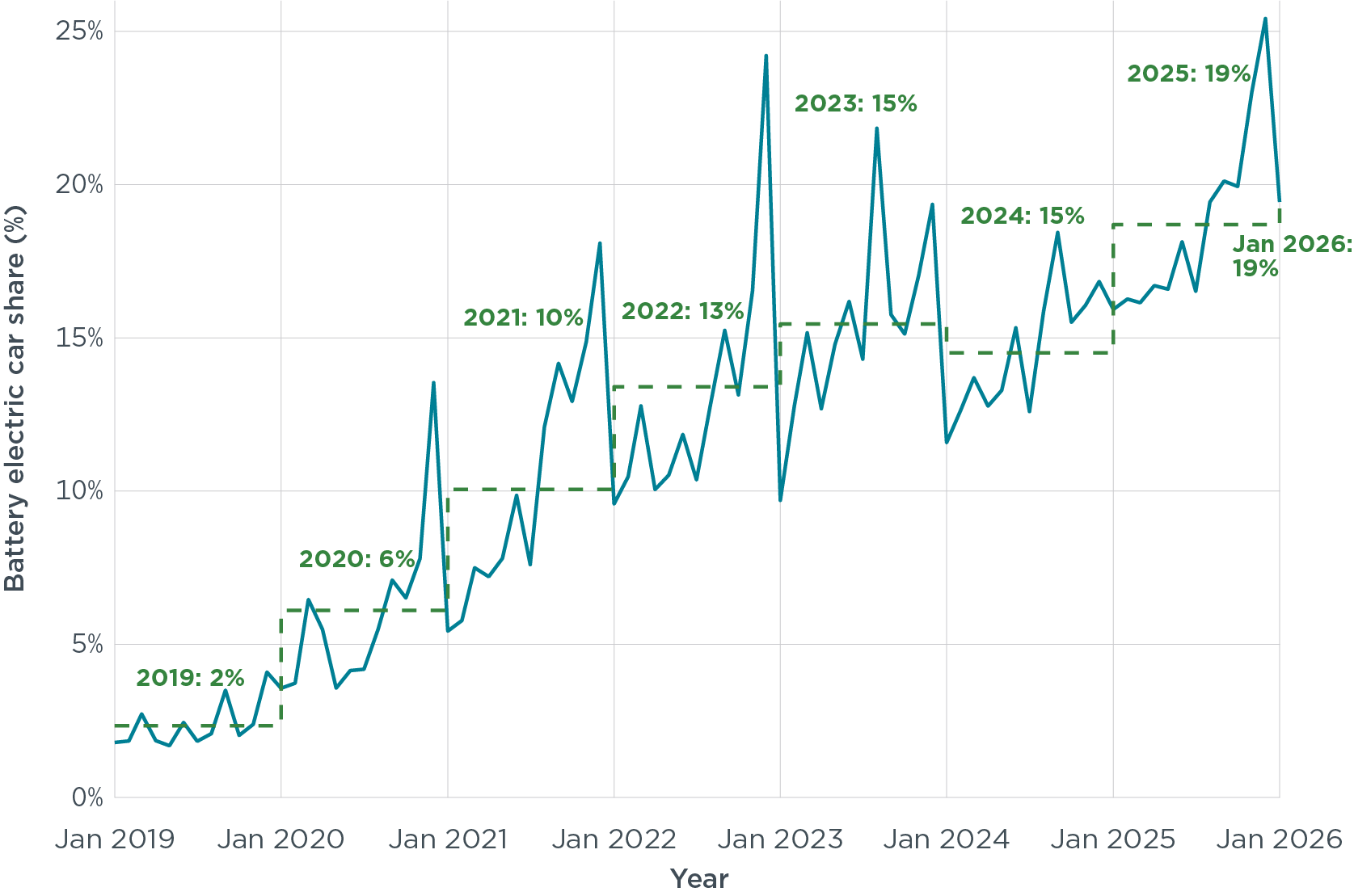
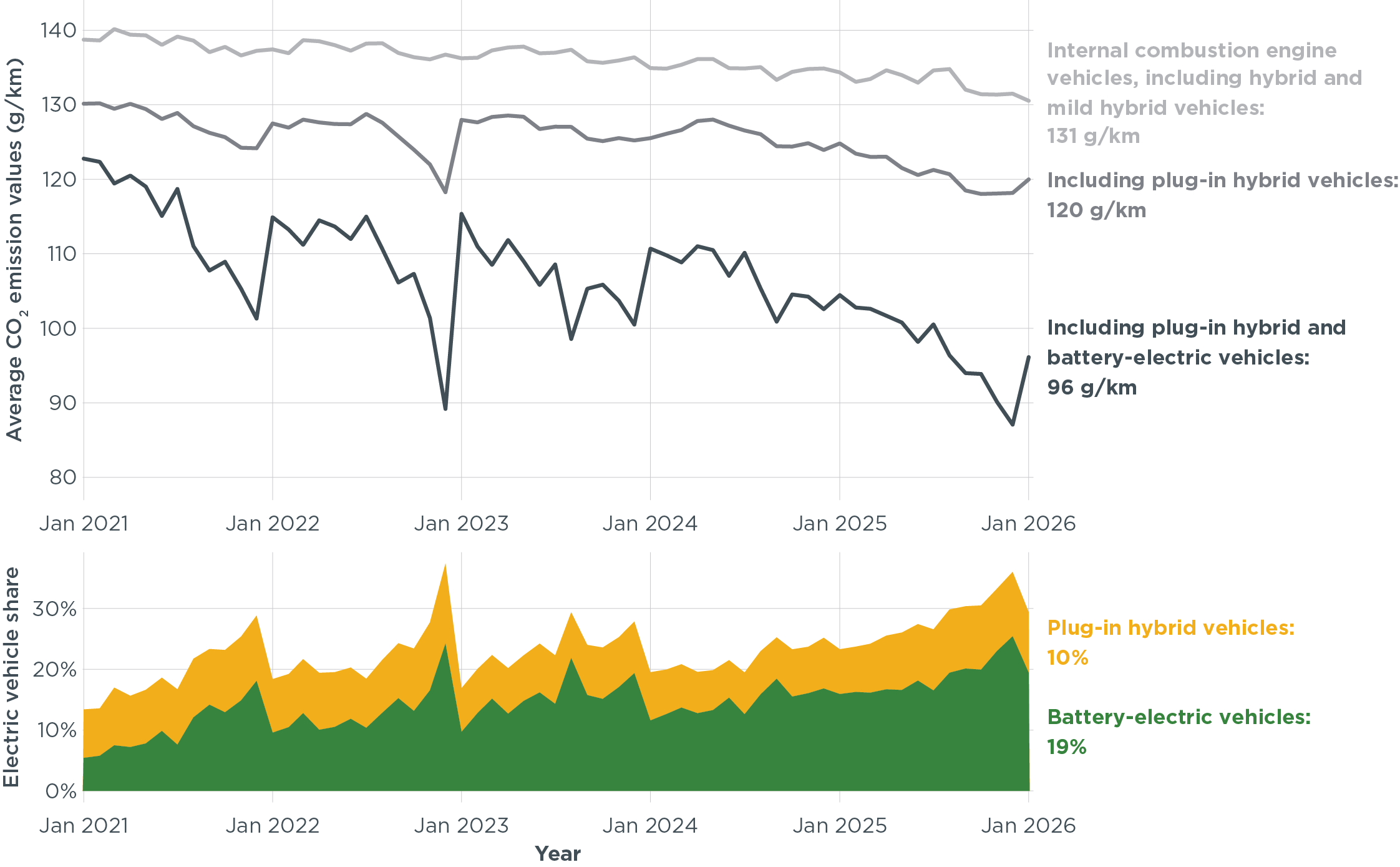
The average share of battery electric vehicles (BEVs) among total new registrations in Europe reached 19% in January, matching the 2025 average and marking a 3-percentage-point increase compared with January 2025. Although this represents a decline from the 25% share reported in December 2025, BEV registrations in January have historically been lower than those recorded during the immediately preceding December (see Figure 1).
Figure 1
Share of battery electric vehicles among new passenger car registrations in Europe
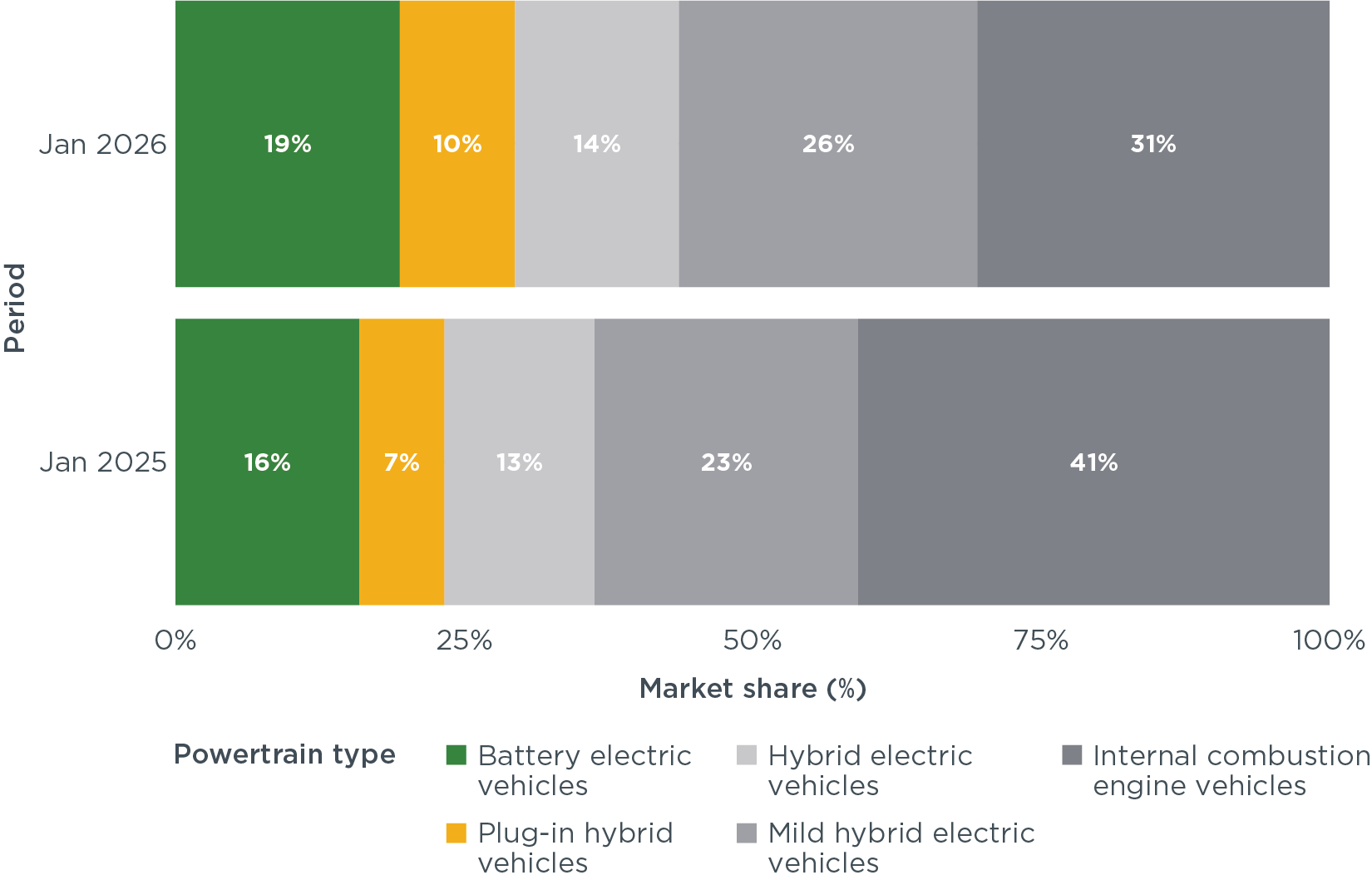
In January 2026, plug-in hybrid vehicles (PHEVs) had an average market share of 10% among new registrations in Europe, up 3 percentage points from January 2025.
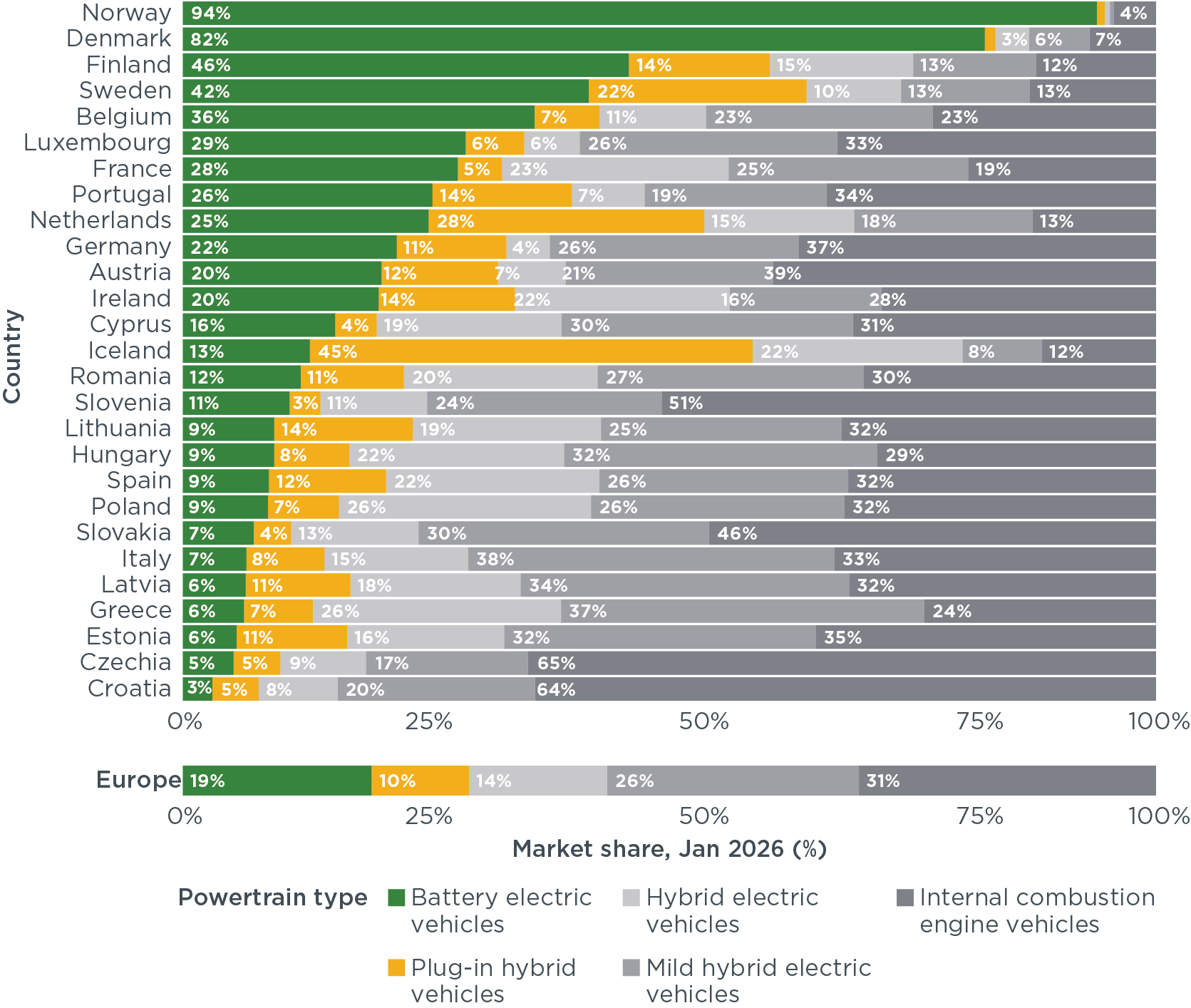
Compared with January 2025, full hybrid (HEVs) and mild hybrid electric vehicles (MHEVs) increased in market share by 1 and 3 percentage points, respectively, in January, reaching shares of 14% and 26%. Meanwhile, conventional internal combustion engine vehicles (ICEVs) comprised 31% of new registrations in January 2026. This is 10 percentage points lower than in January 2025 (see Figure 2).
Figure 2
Europe’s new car market share by powertrain type, January 2026 versus January 2025
Of the 10 largest European markets, Italy registered the biggest increase in total new car registrations (+6%) and Belgium the largest decrease (−18%) in January 2026, compared with January 2025 (see Table A5 in the report). Looking at new BEV registrations, Germany and France had BEV market shares of 22% and 28%, respectively, in January. This represents increases of 5 and 11 percentage points compared with the same month in 2025.
Italy and Spain, the third and fourth largest markets, each had increases of 2 percentage points, reaching BEV shares of 7% and 9%, respectively, in January.
Nordic countries and Belgium led Europe’s battery electric car registration shares. While Norway and Denmark already surpassed the 50% mark at 94% and 82%, respectively, Finland (46%), Sweden (42%), Belgium (36%), Luxembourg (29%), France (28%), Portugal (26%), and the Netherlands (25%) all had BEV shares of 25% or greater in January. Also with BEV market shares above of the European average were Germany (22%), Austria (20%), and Ireland (20%) (see Figure 3). In January 2026, Denmark had the greatest increase compared with the same month in the previous year (+18 percentage points).
Looking at other drivetrains in the largest European markets, PHEVs shares were the highest in the Netherlands (28%) and Sweden (22%) in January. Poland (26%) and France (23%) had the highest HEV shares, while MHEV shares were the highest in Italy, at 38%, followed by Germany, Poland, and Spain, which each had shares of 26%.
Figure 3
Europe’s new car market share by country and powertrain type, January 2026
Under EU regulation, Europe’s carmakers are required to reduce their CO₂ emissions from new cars incrementally until 2035. The current target value applies for each year from 2025 to 2029. However, compliance with the targets will first be assessed at the end of 2027 and will consider the average new car fleet CO₂ emissions from the 2025 to 2027 period. Automakers are permitted to combine their emissions performance across these 3 years through pooling arrangements (manufacturing pools) and may use compliance credits earned by selling zero-and low-emission vehicles as well as by deploying eco-innovations (i.e., technologies that deliver real-world CO₂ savings beyond what is measured over the standardized test cycle during type approval). Increasing the share of battery electric cars is the leading strategy used by manufacturers to achieve these reductions and avoid penalties.
In January 2026, manufacturer CO₂ emissions averaged 97 g CO₂/km. After accounting for compliance credits, manufacturers were, on average, 3 g CO₂/km above the 2026 target (see Table A2 of the report). For the January 2025 to January 2026 period, adjusted emissions stood at 97 g CO₂/km. Including compliance credits, manufacturing pools thus remained 4 g CO₂/km short of the average target of 93 g CO₂/km for the 2025–2027 period, unchanged from the target gap recorded in 2025 (see Table A3 in the report).
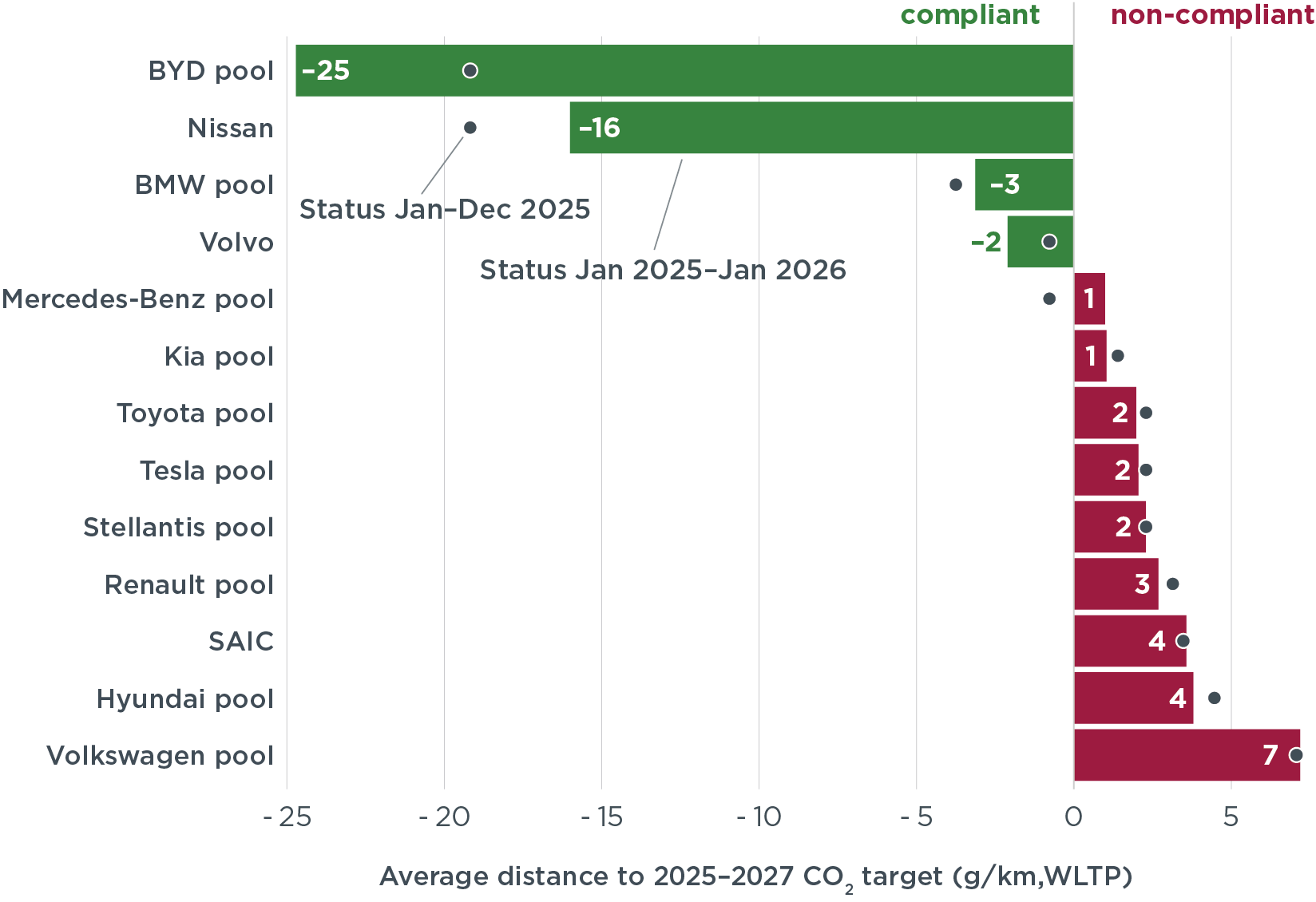
For the January 2025 to January 2026 period, the BYD pool (25 g CO₂/km below), Nissan (16 g CO₂/km below), the BMW pool (3 g CO₂/km below), and Volvo (2 g CO₂/km below) were all meeting their 2025–2027 targets, while the Hyundai and Kia pools reduced their target gaps by 1 g CO₂/km compared with their 2025 averages. The Volkswagen pool (+7 g CO₂/km) remained the farthest from its target (see Figure 4).
Figure 4
Average distance to 2025–2027 CO2 targets for manufacturer pools and individual manufacturers
The BYD pool and Volvo had the largest BEV registration shares in January 2026, at 55% and 37%, respectively. The Kia (26%), BMW (25%), Tesla (25%), and Hyundai (22%) pools also had shares above the European average. Nissan (6%), the Toyota pool (7%), and SAIC (11%) had the lowest BEV shares in January (see Table A1 in the report).
Looking at individual car brands with market shares of 1% or greater, Tesla and BYD had the greatest over-compliance at 92 g CO2/km and 82 g CO2/km, respectively, below their projected brand-level average targets for 2025–2027, followed by Volvo (31 g CO2/km below), Mini (19 g CO2/km below), and Cupra (18 g CO2/km below). The brands with the largest target gaps were Nissan (28 g CO2/km above), SEAT (24 g CO2/km above), Mercedes-Benz (19 g CO2/km above), and Mazda (18 g CO2/km above; see Table A4 of the report).
Among the largest carmakers, the Hyundai Group had the greatest increase in BEV market share in January 2026, increasing 7 percentage points compared with January 2025. With a 27% market share in January 2026, the Volkswagen Group increased its BEV share by 2 percentage points over the same period.
Table 1
Share of battery electric and plug-in hybrid cars for the top seven manufacturer groups, January 2026
| Manufacturer group | Battery electric car share | Plug-in hybrid car share | Market share Jan 2026 | ||
|---|---|---|---|---|---|
| Jan 2026 | Change vs. Jan 2025 | Jan 2026 | Change vs. Jan 2025 | ||
| BMW Group | 25% | + 1 p.p. | 15% | −1 p.p. | 7% |
| Hyundai Group | 24% | + 7 p.p. | 8% | + 1 p.p. | 7% |
| Mercedes-Benz Group | 20% | + 2 p.p. | 19% | + 2 p.p. | 6% |
| Renault Group | 19% | + 5 p.p. | 1% | < 1 p.p. | 10% |
| Volkswagen Group | 19% | + 2 p.p. | 12% | + 5 p.p. | 27% |
| Stellantis | 16% | + 4 p.p. | 3% | + 1 p.p. | 18% |
| Toyota Group | 7% | + 2 p.p. | 7% | < 1 p.p. | 8% |
Battery electric cars are the powertrain with the largest potential to reduce total CO2 emissions2. When looking at new registrations of ICEVs (including HEVs and MHEVs) alone, CO2 emissions averaged 131 g CO2/km in January. Including PHEVs reduced the average to 120 CO2/km, while the increasing market share of BEVs reduced average CO2 emissions by an additional 24 g CO2/km in January (see Figure 5).
Figure 5
Average CO2 emissions of newly registered internal combustion engine vehicles and fleet-average reductions associated with including electrified powertrains
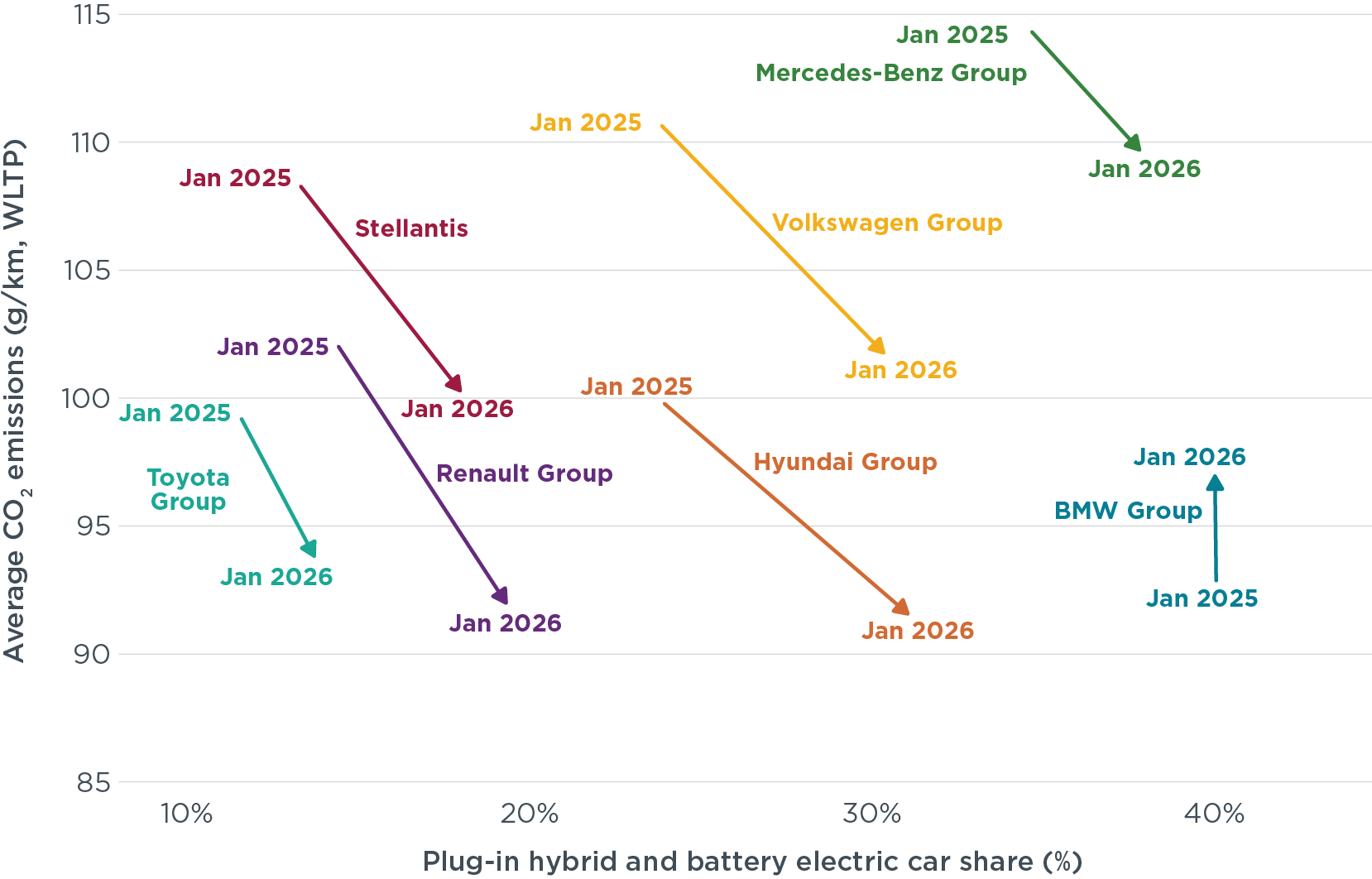
Looking at the relationship between electric car shares and average CO2 emissions, the Mercedes-Benz group had the highest average emissions of the top manufacturers in Europe, while having the second highest share of PHEVs and BEVs in January 2025 and January 2026. This is largely due to the high average CO2 emissions of the group’s non-electrified powertrains, which stood at 164 g CO2/km in January 2026, the highest level among Europe’s largest carmaker groups. With its focus on hybrid powertrains, Toyota had average CO2 emissions meeting the 2026 target in January despite maintaining the lowest electric vehicle share (see Figure 6).
Figure 6
Fleet-average CO2 emissions compared with electric vehicle share by manufacturer group, January 2026 versus January 2025
The think tanks Agora Verkehrswende (Germany), alinnea (Spain), ECCO Climate (Italy), the International Council on Clean Transportation (ICCT), the Mobility in Transition Institute (IDDRI-IMT, France), and the Polish Association for New Mobility (PSNM, Poland) publish monthly data on the average specific emissions of newly registered vehicle fleets in the European Economic Area, both overall and by country.
These data make it possible to track manufacturers’ compliance gap with respect to the CO₂ reduction targets (Regulation 2019/631) set for the 2025–2027 period, as well as the reduction of CO₂ emissions from new vehicles through 2035.
alinnea provides the report data with a particular focus on Spain, the fourth-largest automotive market in Europe.